
When most people talk about an insulated glass unit (IGU), the conversation stops at glass thickness: “6 mm + 12 mm air space + 6 mm.” But that number tells you almost nothing about how the unit will actually perform once it’s sitting in a wall, facing the weather, the sun, and years of thermal cycling.
An IGU is not a single product. It’s a chain of decisions made by different people at different stages: the architect who writes the spec, the fabricator who seals the unit, the builder who designs the envelope around it, and the installer who sets it into the frame. That chain is only as strong as its weakest link. Miss one detail anywhere along it, and a technically “correct” IGU can still fog, crack, leak, or simply underperform for decades.

Below are 10 details that are frequently overlooked at one stage or another, and why each one deserves more attention than it usually gets.
1. Specifying Glass by Thickness Instead of Performance
For measurement, “6-12-6” describes a stack-up. It says nothing about what the glass actually does once it’s installed. Yet it’s still the most common shorthand used in specs, RFQs, and even construction documents — largely because it’s easy to write down and easy to compare against a competitor’s quote.
The problem is that two IGUs with identical thickness callouts can perform completely differently depending on:
- U-factor — how much heat moves through the assembly by conduction, convection, and radiation. A lower U-factor means less heat loss in winter and less heat gain in summer.
- SHGC (Solar Heat Gain Coefficient) — how much solar radiation passes through as heat. This matters enormously on south- and west-facing elevations.
- Visible transmittance — how much usable daylight actually reaches the interior, independent of heat.
- Low-E coating type and placement — which surface the coating sits on (surface 2 or surface 3) changes whether the unit is optimized for heat retention or heat rejection.
- Solar orientation and climate zone — the “right” glass for a north-facing unit in Minneapolis is often the wrong glass for a west-facing unit in Phoenix.
- Acoustic requirements — laminated interlayers and asymmetric pane thickness can meaningfully cut sound transmission, but only if specified.
- Safety glazing requirements — code-mandated in hazardous locations (doors, low sills, stair landings) regardless of the thermal spec.
- Wind load and thermal stress exposure — determines minimum glass thickness and whether tempering or heat-strengthening is required, independent of the U-factor target.
A glass specification should start with what the building needs to do — block heat, admit daylight, meet acoustic targets, survive wind load, satisfy code — and work backward to the glass makeup that achieves those outcomes. Thickness is a byproduct of that process, not the starting point. When it’s treated as the starting point instead, the result is often a unit that meets a nominal callout on paper but underperforms in the field.
2. Assuming the IGU Can Compensate for a Weak Building Envelope
It’s tempting to think of the IGU as a self-contained performance unit — spec a good one, and the rest takes care of itself. It doesn’t work that way. An IGU’s real-world performance is inseparable from the system it sits inside.
Consider what surrounds every IGU once it’s installed:
- Window and façade system design — the frame, mullions, and glazing pockets that hold the unit in place.
- Frame thermal breaks — without them, the frame becomes a direct conductive path for heat, undermining even a triple-Low-E unit.
- Air leakage control — gaps and poor gasketing around the perimeter let conditioned air escape regardless of how well-sealed the IGU itself is.
- Water management and drainage paths — every glazing system needs a way to shed water that gets past the outer seal; if that path is blocked or absent, water sits against the IGU edge seal indefinitely.
- Installation tolerances — how much room the design allows for expansion, contraction, and minor field adjustment.
- The interface between glazing and wall assembly — flashing, sealant joints, and transitions where the glazing system meets the surrounding wall.
Even a high-performance IGU can’t fix a poorly designed envelope around it. If the surrounding system leaks air, traps standing water at the sill, or lacks a thermal break in the frame, the IGU is fighting a losing battle no matter how well it was manufactured. This is why performance complaints that get blamed on “bad glass” often trace back to envelope design decisions made long before the glass order was ever placed.
3. Overlooking What’s Happening Inside the Unit
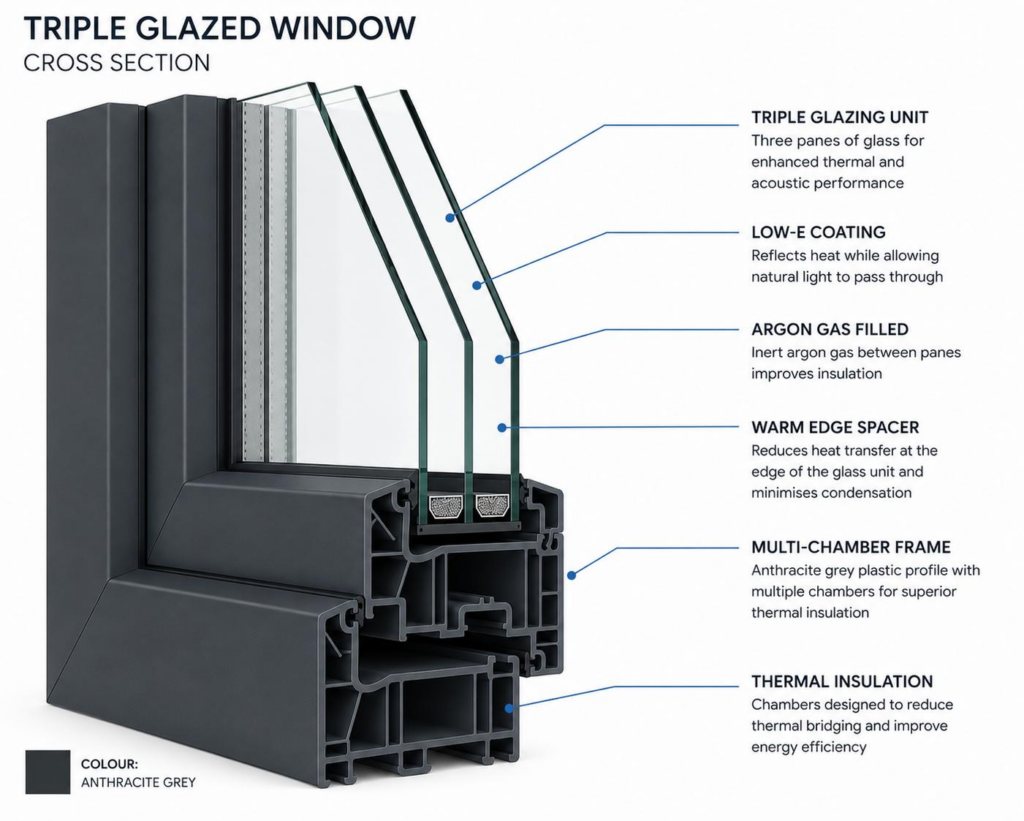
The visible glass surfaces are only part of the story. Everything that determines an IGU‘s long-term durability is sealed inside the edge, invisible once the unit ships:
- Spacer system design — the material and profile that separates the two panes and maintains the cavity width. Warm-edge spacers (foam, structural silicone, or hybrid designs) reduce edge-of-glass heat loss compared to traditional aluminum spacers.
- Desiccant — a material inside the spacer that absorbs residual moisture trapped during manufacturing, keeping the cavity dry for the life of the unit.
- Primary seal — typically polyisobutylene (PIB), this is the actual moisture and gas barrier. It’s the seal that keeps argon in and water vapor out.
- Secondary structural seal — usually silicone or polysulfide, this seal provides the structural bond that holds the two panes together against wind load and thermal movement.
- Gas fill and fill accuracy — argon or krypton improves insulating performance, but only if the fill percentage is accurate and stable at the time of sealing.
- Low-E coating application — how consistently and precisely the coating is applied affects both optical clarity and thermal performance.
- Glass washing and surface preparation — contamination on the glass surface before sealing can compromise seal adhesion from day one.
- Sealant compatibility with coatings, gaskets, and adjacent materials — incompatible chemistries can degrade the seal from the inside out.
None of this is visible during a site walkthrough, and most of it won’t show any symptoms for years. That’s exactly why manufacturing quality matters so much — it’s the difference between an IGU that holds its seal for 20+ years and one that starts fogging in year six, long after the installer and even the original project team have moved on.
4. Treating Installation as an Afterthought
A perfectly manufactured IGU can be compromised in minutes on site, and installation is often the least scrutinized stage in the entire chain — despite being one of the most consequential.
Details that routinely get overlooked during installation include:
- Correct setting blocks — placed at the quarter points of the sill to properly distribute the unit’s weight; incorrect placement concentrates stress at the edge seal.
- Proper glass bite — how far the glass edge sits inside the frame rabbet. Too little bite risks the unit working loose under wind load; too much can restrict necessary movement.
- Adequate edge clearance — the gap between the glass edge and the frame, needed to accommodate thermal expansion and building movement.
- Preventing glass-to-metal contact — direct contact creates stress risers and can lead to edge chipping or cracking.
- Avoiding improper shimming — makeshift shims can throw off bite and clearance tolerances simultaneously.
- Sealant compatibility at the frame interface — the field-applied sealant must be chemically compatible with the IGU’s factory seal.
- Functional frame drainage — weep holes and drainage channels need to stay clear during and after installation, not just on the shop drawing.
- Careful handling, storage, and edge protection before the unit ever reaches the opening.
A high-performance IGU can still underperform — or fail prematurely — if it’s installed incorrectly, and the failure often shows up long after the installation crew has left the job. That delay is part of why installation-related root causes are so easy to miss during warranty investigations. Installation isn’t the last step in the process; it’s part of the performance spec, and it deserves the same level of attention as the glass makeup itself.

6. Misdiagnosing Condensation and Fogging
“My window is fogging” is one of the most common complaints glass professionals hear — and one of the most frequently misdiagnosed. Not every foggy window means the IGU itself has failed. There are two distinctly different phenomena at play, and they call for completely different responses.
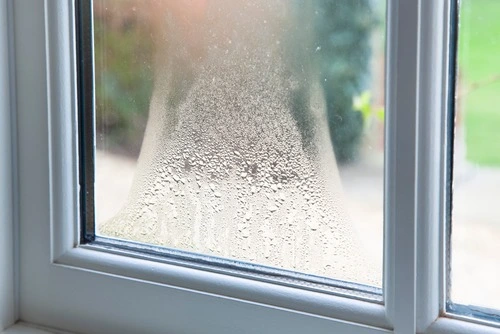
Condensation on the room-side surface happens on the interior face of the inner pane, and it’s typically caused by conditions inside the building, not a defect in the glass:
- Elevated indoor humidity (common in kitchens, bathrooms, and newly built homes still drying out)
- Cold outdoor temperatures dropping the interior glass surface temperature below the dew point
- Poor ventilation that lets humidity build up without an outlet
- Locally, a colder spot on the glass caused by spacer performance at the edge
Condensation between the glass panes, by contrast, appears inside the sealed cavity itself and is a genuine sign of trouble:
- It typically indicates seal failure, allowing outside moisture to migrate into the cavity
- It can also point to desiccant saturation or spacer degradation that’s no longer able to manage residual moisture
The important distinction to communicate to a customer, contractor, or building owner is simple: fogging on the outer or inner glass surface is almost always a building-conditions issue, solvable with ventilation or humidity control. Fogging trapped between the panes means the seal has failed and the unit needs to be replaced. Confusing the two leads to unnecessary IGU replacements in some cases, and missed warranty claims in others.
7. Ignoring Altitude and Pressure Differences
This is a niche topic, but it’s one that experienced glass professionals know can cause real problems — and it rarely makes it into a typical spec conversation. An IGU manufactured at one elevation and installed at a significantly different one can experience internal pressure changes that physically deform the glass.
Here’s why: an IGU is sealed with a fixed volume of gas inside it at the elevation (and corresponding atmospheric pressure) where it was fabricated. If that unit is then shipped to and installed at a meaningfully different elevation, the difference in outside atmospheric pressure relative to the sealed internal pressure causes the panes to bow — inward if the installation site is at a higher elevation than the factory, outward if it’s lower.
Factors that determine how significant this effect will be:
- IGU cavity pressure at the moment the unit was sealed
- The elevation difference between the fabrication plant and the job site — generally, differences above roughly 1,000–2,500 feet start to warrant attention, though the exact threshold depends on unit size and glass thickness
- Shipping and transport conditions, including whether the unit passed through pressurized cargo holds or over mountain passes
- Deflection tolerances for the specific unit size, since larger lites bow more noticeably than smaller ones under the same pressure differential
For projects with large elevation changes between the factory and the job site — a coastal fabrication plant shipping to a mountain-region project, for example — this is worth raising with the fabricator early. Most manufacturers can compress or adjust the fill pressure at the factory to compensate, but only if they know the installation elevation in advance.
8. Skipping Sealant and Material Compatibility Checks
Not all sealants, gaskets, coatings, and frame materials are chemically compatible with each other, and this is one of the least visible risks in the entire IGU system. A silicone secondary seal that isn’t compatible with a particular gasket material, or a field sealant applied at the frame interface that reacts poorly with the factory-applied primary seal, can slowly break down a bond that would otherwise last decades.
These incompatibilities rarely show up immediately. They tend to surface years later as gradual seal degradation — long after the original installation team, and often the original building owner, has moved on. That lag is exactly what makes compatibility checks easy to skip in the moment and expensive to ignore in the long run. Confirming compatibility between the IGU manufacturer’s sealants and any field-applied materials is a five-minute conversation that prevents a much longer one later.
9. Underestimating Handling and Storage Before Install
A surprising share of IGU damage happens before the unit ever reaches the frame it was made for. Edge damage, moisture intrusion at a nicked seal, and micro-fractures in the glass often trace back to how the unit was handled, shipped, or stored on site — not to anything that happened in the factory or during installation itself.
Common failure points during this stage include:
- Units stored flat instead of vertically on proper A-frame or L-frame racks, which puts uneven pressure on the lowest lites in the stack
- Missing or inadequate edge protection during transport, leaving the vulnerable seal exposed to impact
- Prolonged exposure to direct sun or standing water while staged on site before installation
- Improper lifting technique that flexes large lites beyond their design tolerance
None of these details require special equipment or training to get right — they require treating the IGU as a finished precision product from the moment it leaves the factory, not just “glass” that can be handled the way lumber or drywall might be.
10. Forgetting That It’s a Chain, Not a Single Product
Zoom out, and the full IGU performance chain looks like this:
Glass → Low-E coating → Spacer → Gas fill → Sealants → Frame → Glazing system → Installation
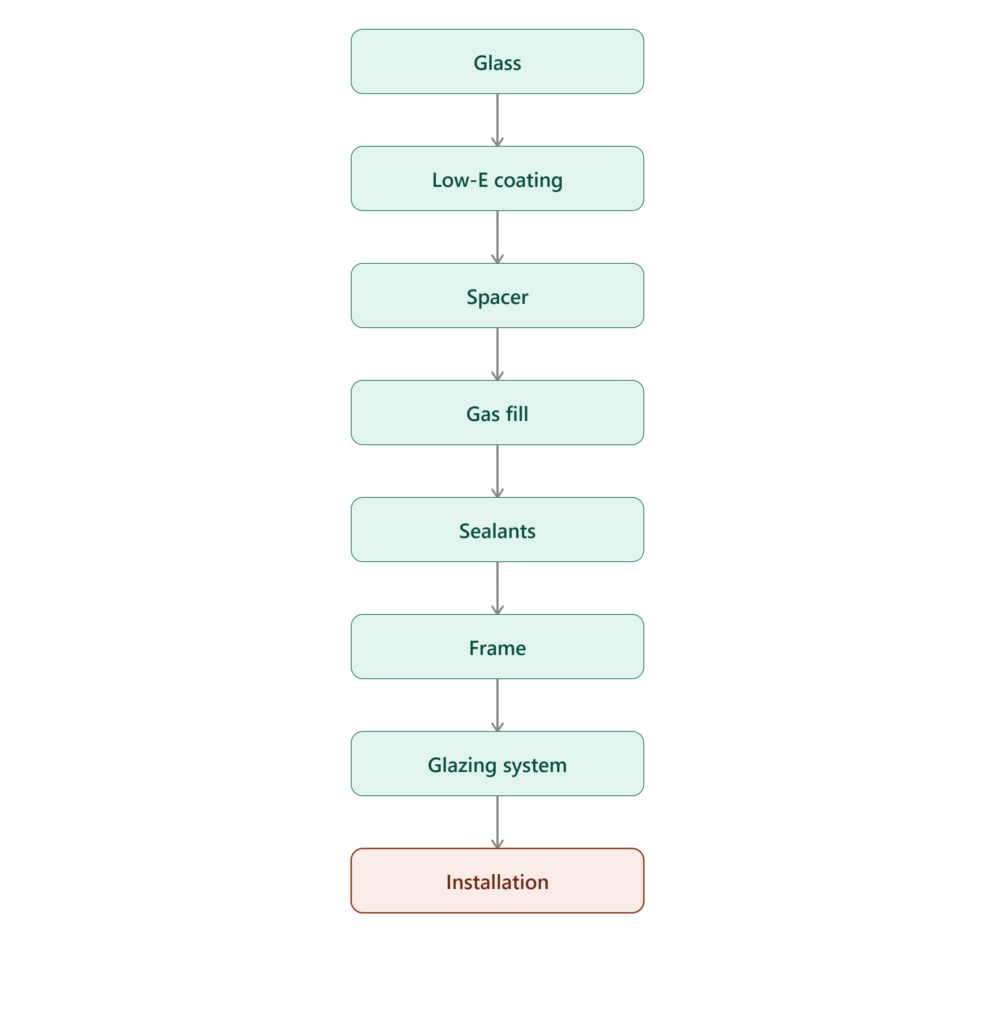
Each link depends on the one before it, and no link can compensate for a failure in another. A perfect fabrication process doesn’t matter if the installation crew shims the unit incorrectly. A perfect installation doesn’t matter if the wrong glass makeup was specified in the first place. A flawless spec doesn’t matter if the surrounding envelope leaks air around every edge.
That interdependency is the single most important thing to understand about IGU performance — and the reason “the glass failed” is so often the wrong diagnosis. More often, one specific link in a much longer chain gave way, and identifying which one is the difference between fixing the real problem and replacing a unit that was never actually the cause.
The Takeaway
The performance of an insulated glass unit isn’t determined by the glass alone — it’s determined by how well every component and every trade works together, from the first line of the spec to the last bead of sealant at the frame. Architects, builders, fabricators, and installers each hold one link in that chain, and each one has the power to strengthen it or weaken it.
The next time an IGU underperforms, the question worth asking isn’t “was the glass bad?” It’s “which link in the chain gave way — and at what stage?”