For a long time, a glass company’s product range was set by what its cutting table could do. Straight cuts, simple shapes and standard sizes were easy. Everything else was slow, expensive or avoided altogether.
That limit is moving. In 2026, CNC glass cutting is no longer one machine doing one job. It is a family of technologies (mechanical, abrasive, laser-based and robotic) connected by software and increasingly by data. Together they are changing what fabricators can offer architects, builders and commercial specifiers.
This article looks at the mechanisms inside these machines and, more importantly, at how each one opens the door to products that were hard to make a few years ago.
The Core Idea: Each Cutting Mechanism Solves a Different Problem
There is no single “best” CNC glass cutting method. Each mechanism has a job it does well and a limit it can’t cross. Modern fabrication is about choosing, and combining, the right ones.
| Mechanism | How It Cuts | Where It Shines | Typical Limit |
|---|---|---|---|
| Score-and-break (CNC cutting table) | A wheel scores the surface, then the sheet is separated along the line | Fast, clean cutting of flat sheets, including nested layouts | Best suited to straight and gently curved paths |
| CNC machining centre (diamond tooling) | A spindle with diamond tools grinds, drills and shapes the glass | Holes, notches, internal cut-outs, contours and edge shaping | Slower than scoring for simple cuts |
| Waterjet | A high-pressure stream, usually carrying abrasive, erodes the glass along the path | Tight internal shapes, thick or laminated glass, intricate contours | Slower; edge usually needs finishing |
| Laser processing | Focused laser energy cuts, marks or modifies glass without a physical blade | Precision work, fine features, marking | Suited to specific glass types and applications |
Mechanism 1: Score-and-Break, Now With Closed-Loop Control
The classic method is still the workhorse for flat glass, but the mechanism has been refined.
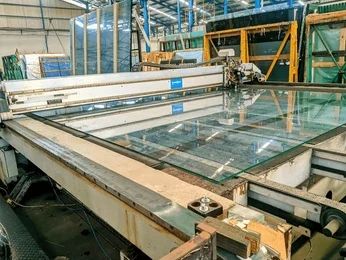
How it works. A cutting wheel travels along a programmed path and creates a score line on the glass surface. The sheet is then broken along that line. On a CNC cutting table, the path, speed and pressure are all controlled by the machine.
What has changed. Modern systems monitor and adjust cutting conditions rather than just repeating a fixed setting. Pressure and speed can be controlled and adapted for different glass thicknesses and coatings, and tool heads can be changed quickly between jobs.
Why it matters for products. Consistent scoring means cleaner, more predictable breaks, which supports tighter dimensional control and fewer rejected sheets. For fabricators, that makes it practical to take on more varied orders on the same machine, from standard panels to custom sizes in small batches.
Mechanism 2: CNC Machining Centres and the Rise of Feature-Rich Glass
Many modern glass products are defined less by their outline than by what has been machined into them: holes for hardware, notches for fittings, cut-outs for outlets and handles.
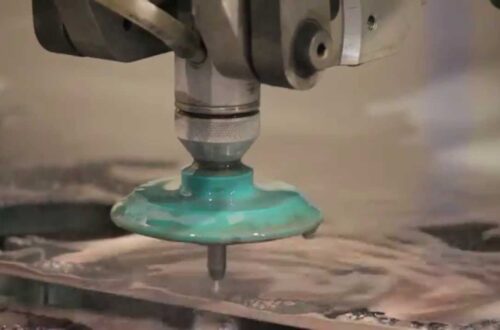
How it works. A CNC machining centre uses a spindle fitted with diamond tooling. It can drill, mill, grind and shape the glass under programmed control, usually with coolant to manage heat and keep the tool cutting cleanly.
What has changed. Machines now combine several operations in one setup (cutting contours, drilling, creating cut-outs and shaping edges), which reduces handling and the risk of cumulative error between operations.
Why it matters for products. This is the technology behind glass that arrives ready to install: railing panels with precise hardware holes, shower enclosure glass with exact notches, shelving and furniture glass with detailed cut-outs. Because holes and edges are processed in a controlled sequence, the finished part is more likely to fit on site the first time.
Reminder: For tempered glass, all cutting, drilling and edge work must be completed before tempering. This is why accuracy at the CNC stage matters so much for safety glass products.
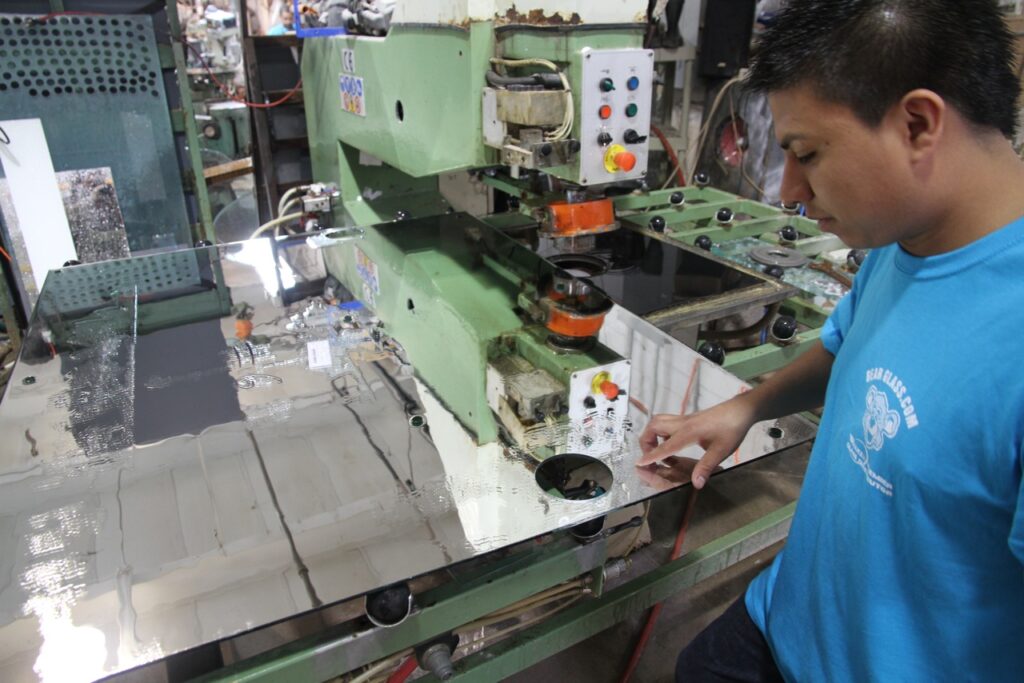
Mechanism 3: Waterjet Cutting and the Freedom of Complex Shapes
When a design calls for tight curves, internal shapes or unusual contours, waterjet is one of the most flexible tools available.
How it works. A narrow, high-pressure stream of water, typically carrying abrasive, is directed along a programmed path. The stream erodes the glass rather than breaking it along a score line, so the path isn’t limited to straight lines.
What has changed. Waterjet systems are increasingly part of automated fabrication cells, and the demand for complex contours, including three-dimensional shapes in sectors such as automotive glazing, has pushed the technology forward.
Why it matters for products. Waterjet makes it practical to offer custom-shaped glass: decorative panels, feature tabletops, unusual architectural inserts and intricate internal cut-outs. It also gives fabricators a route for thicker and laminated glass where other methods are less suitable.
What to keep in mind: waterjet-cut edges usually need further finishing, so the workflow after cutting, covered in our guide to [CNC Glass Cutting to Edgework], still decides the final quality.
Mechanism 4: Laser Processing Enters the Mainstream Conversation
Lasers are one of the most talked-about developments in glass processing for 2026. Equipment makers are exhibiting laser-based systems, including solutions that combine more than one laser process in a single machine, aimed at flexible, highly precise glass machining.
How it works. Instead of a physical wheel or tool, focused laser energy is used to cut, mark or modify the glass. Because there’s no tool contact, the process can deliver fine detail.
What has changed. Lasers are moving from specialist niches toward broader industrial use, and industry commentary stresses that taking full advantage of them takes more than swapping one machine for another. The surrounding workflow, software and glass type all matter.
Why it matters for products. Laser-based processing supports fine features and precise marking, which opens opportunities in specialty and technical glass. For most architectural fabricators, the practical question is not “laser or not?” but “which jobs justify it?”
The Hidden Layer: Software, Nesting and Data
The mechanisms above get the attention, but software does much of the work behind the scenes.
- Nesting and optimisation. Software arranges parts on a sheet to reduce offcuts. Less waste means lower material cost and a smaller environmental footprint, which matters as recycling and CO₂ reduction are among the headline topics at this year’s industry trade fair.
- Order-to-delivery digital flow. Leading equipment suppliers now emphasise digital processes that run from order entry through production to delivery, reducing re-keying and errors.
- Machine vision and inspection. Cameras and sensors can check parts for defects during or immediately after processing, bringing inspection closer to the cutting step instead of leaving it to the end.
- Connected machines. Machines that share data with other systems help fabricators plan, track and maintain production more reliably.
For the customer, this layer is invisible, but it shows up as shorter lead times, fewer errors and more consistent parts.
Automation and Robotics: Handling Is Part of Cutting
Glass is heavy, fragile and awkward. A growing share of the progress in 2026 is about moving it safely and consistently.
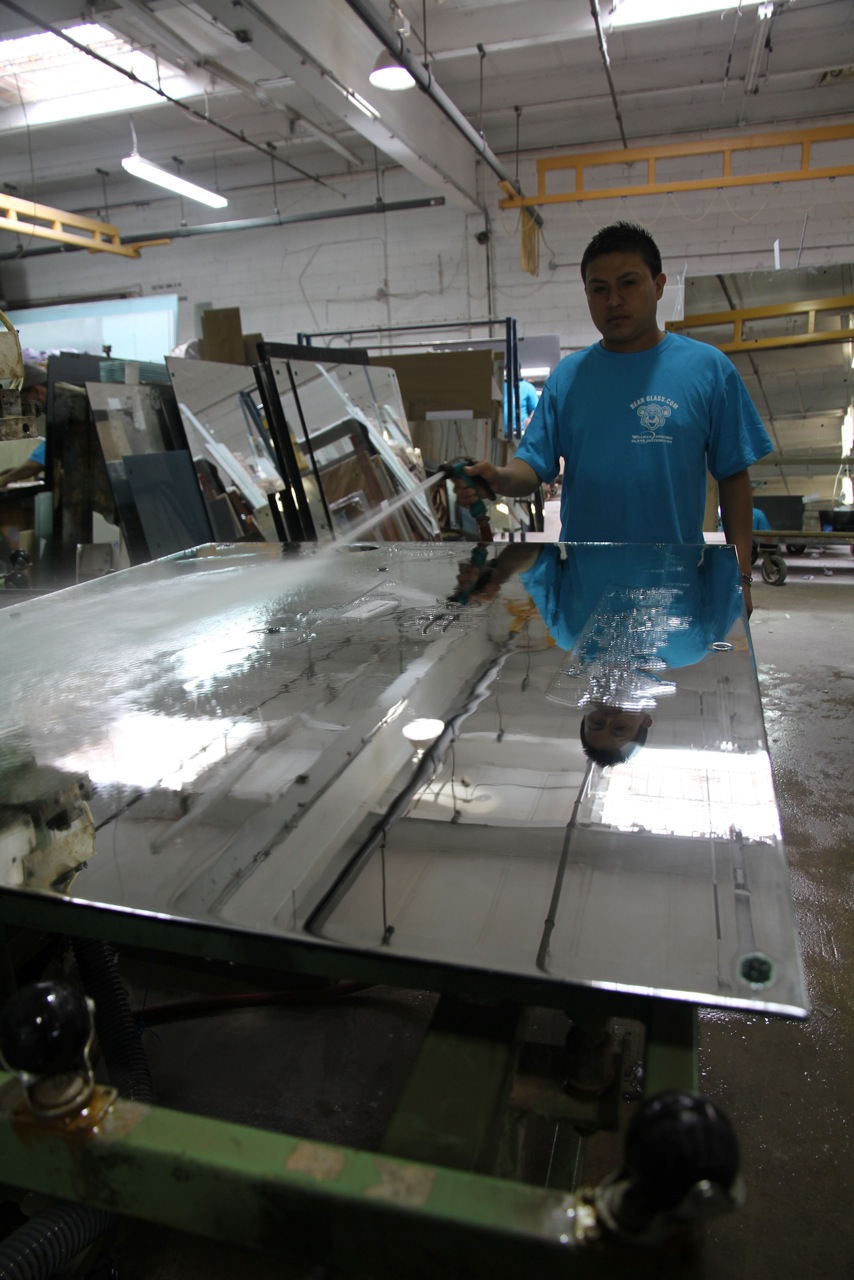
Suppliers are introducing more automated and robotic lines covering handling, grinding and washing, alongside smart automation aimed at smaller operations as well as large plants. Intelligent logistics concepts are also being promoted to shorten internal transport distances and make better use of floor space.
The benefit is not only speed. Less manual handling means less risk of chips, scratches and breakage, all of which cost time and material.
What These Changes Mean for the Products Glass Companies Can Offer
Put the mechanisms and the software together, and the product opportunities become clear.
1. More custom, less compromise. Complex contours, internal cut-outs and unusual shapes are easier to produce reliably, so designers are less constrained.
2. Hardware-ready and installation-ready glass. Precise holes, notches and edges mean components arrive ready to fit, reducing site adjustments.
3. Smaller batches without big penalties. Programmable machines and quick tool changes make short runs and one-off pieces more practical.
4. Better material efficiency. Optimised layouts and controlled processes reduce waste, supporting both cost and sustainability goals.
5. More consistent quality. Automated handling, monitored cutting and earlier inspection help keep results uniform across large orders.
6. Faster turnaround. Combining operations, integrating software and reducing manual steps all shorten the path from drawing to finished part.
What Hasn’t Changed: Edgework, Tolerances and Inspection
New machines don’t remove the fundamentals. A part that is cut accurately still has to be edge-processed, finished and inspected, and the dimensions after edgework are the ones that count. Each cutting mechanism leaves a different starting edge, so the edge-processing route has to match the method.
That’s why the best results in 2026 come from fabricators who control the whole workflow, from drawing to cutting to finishing to inspection, instead of relying on any one machine.
Questions to Ask Your Fabricator
If you’re specifying custom glass this year, these questions help you understand what a fabricator can really deliver:
- Which cutting methods do you use, and how do you decide which one suits my design?
- Can you handle complex contours, internal cut-outs and tight radii?
- How do you control dimensions after edgework, not just after cutting?
- Which glass types and thicknesses can you process, including laminated glass?
- When in the process do you inspect, and what do you check?
- How do you reduce waste and offcuts on custom orders?
Key Takeaways
- CNC glass cutting in 2026 is a combination of mechanisms, not a single machine type.
- Score-and-break, machining centres, waterjet and laser each solve different problems.
- Software, nesting, machine vision and automation increasingly decide speed, waste and consistency.
- These advances let glass companies offer more complex, installation-ready and customised products.
- Edgework, tolerances and inspection remain essential to final quality.
Plan Your Next Glass Project With Bear Glass
Bear Glass works with architects, builders, glazing contractors and commercial specifiers across New York and New Jersey. If your project involves custom shapes, precise cut-outs, or tight tolerances, send us your drawings and requirements, and our team will help you choose the right approach. To connect, visit https://bearglass.com/contacts.php