From raw-cut glass to polished perfection — why the edge is where safety meets craftsmanship, and how Bear Glass has mastered every profile.
Glass, in its raw form, is unforgiving. The moment a sheet is cut, it bears a razor-sharp edge capable of causing serious injury on contact. But in the hands of a skilled glazier, that same edge transforms into a feature — a precise, beautiful, and structurally sound boundary that defines the character of the finished piece.
Glass edgework is the collective term for all the processes that treat, refine, and shape the cut edge of a glass or mirror panel. It is one of the most technically demanding steps in glass fabrication — and one of the most consequential. Choose the wrong profile, skip the polish, or rush the grind, and an otherwise perfect piece of glass becomes unsafe, unattractive, or prone to chipping.
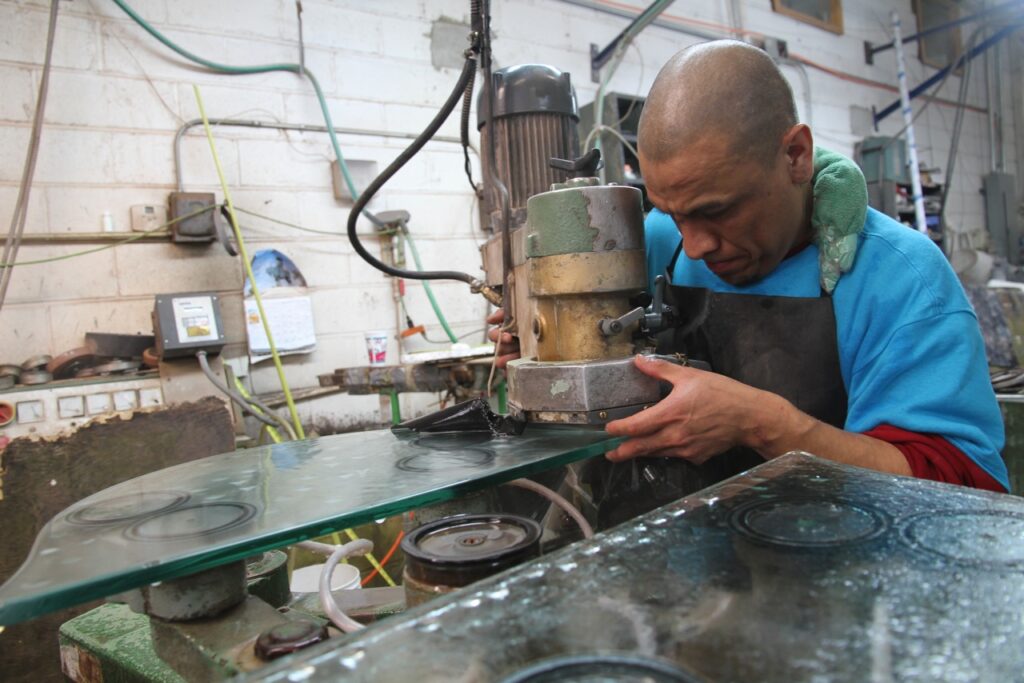
At Bear Glass Inc., a prominent glazier operation with facilities in Queens Village, NYC and Tinton Falls, NJ, glass edgework is not an afterthought. It is a craft. With over four decades of experience and a full suite of electrical and hand tools operated by expert glaziers, Bear Glass produces every edge profile — from the simplest seamed edge to the most elaborate ogee bevel — with exacting precision.
This guide walks through everything you need to know about glass edgework: what it is, why it matters, the full range of profiles available, where each is used, and how Bear Glass delivers it at scale across the United States.
Three core reasons every glass edge needs treatment:
Personal Safety
Unpolished edges cause lacerations during handling, transport, and installation. Seaming or polishing removes the arris and eliminates dangerous sharpness, protecting workers and end-users alike.
Structural Longevity
Grinding removes the stress-fracture zone along the cut. A properly edgeworked panel resists chipping under vibration and thermal movement, lasting significantly longer in service than an untreated equivalent.
Dimensional Tolerance
Edgework is also a precision sizing process. Grinding can correct minor dimensional inaccuracies from cutting, ensuring the glass fits its frame, channel, or installation point exactly — critical for commercial glazing projects.
The Raw Edge Problem — and Why You Cannot Ignore It
When glass is cut using a scoring wheel or waterjet, the resulting edge is structurally compromised. The cut creates microscopic fractures along the glass surface, and the arris — the sharp corner where the flat face of the glass meets the cut edge — is literally blade-like. Touching it without protection can slice skin instantly.
Beyond the immediate injury risk, an untreated edge is a liability in installation. Vibration, temperature cycling, and mechanical stress all focus energy at the edge of a glass panel. Micro-fractures propagate from the arris, leading to chipping, cracking, and in worst cases, spontaneous breakage. This is especially critical for tempered glass, where any post-tempering edge damage can compromise the entire panel’s integrity.
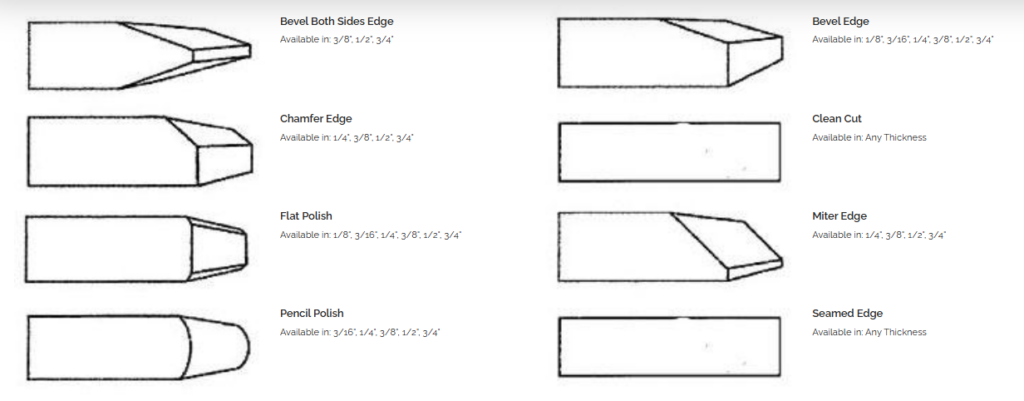
Every Edge Bear Glass Can Deliver
The right edge profile depends on the application, the thickness of the glass, the desired aesthetic, and the visibility of the edge in the finished installation. Bear Glass offers the full spectrum — from purely functional to architecturally decorative.
Applications Across Residential & Commercial Projects
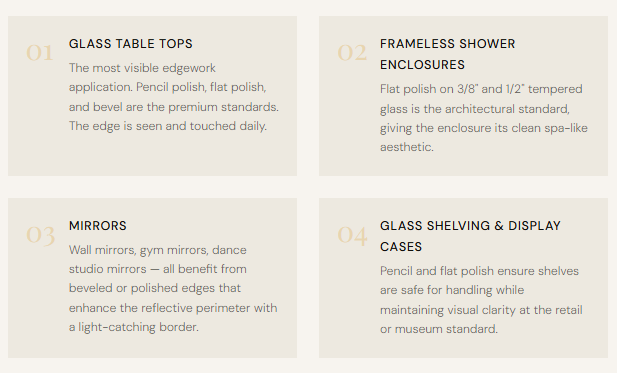
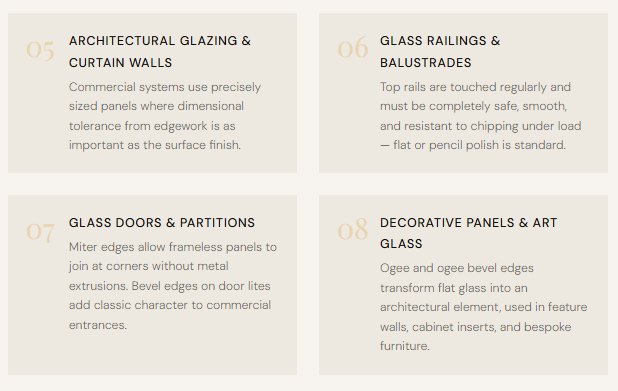
Edgework decisions ripple through every part of a project — from design intent to installation ease to long-term safety. Here are the most common contexts where Bear Glass edgework makes the difference.
How Bear Glass Executes Edgework
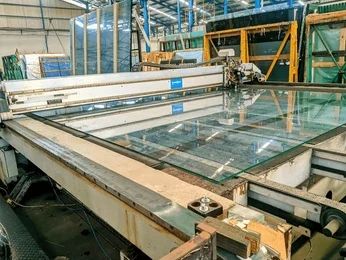
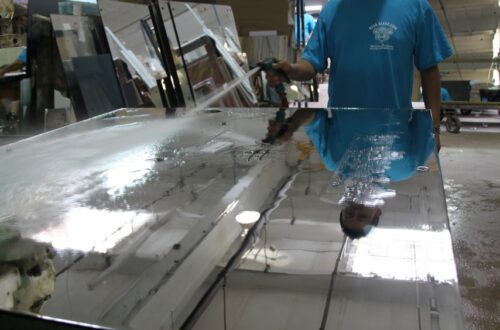
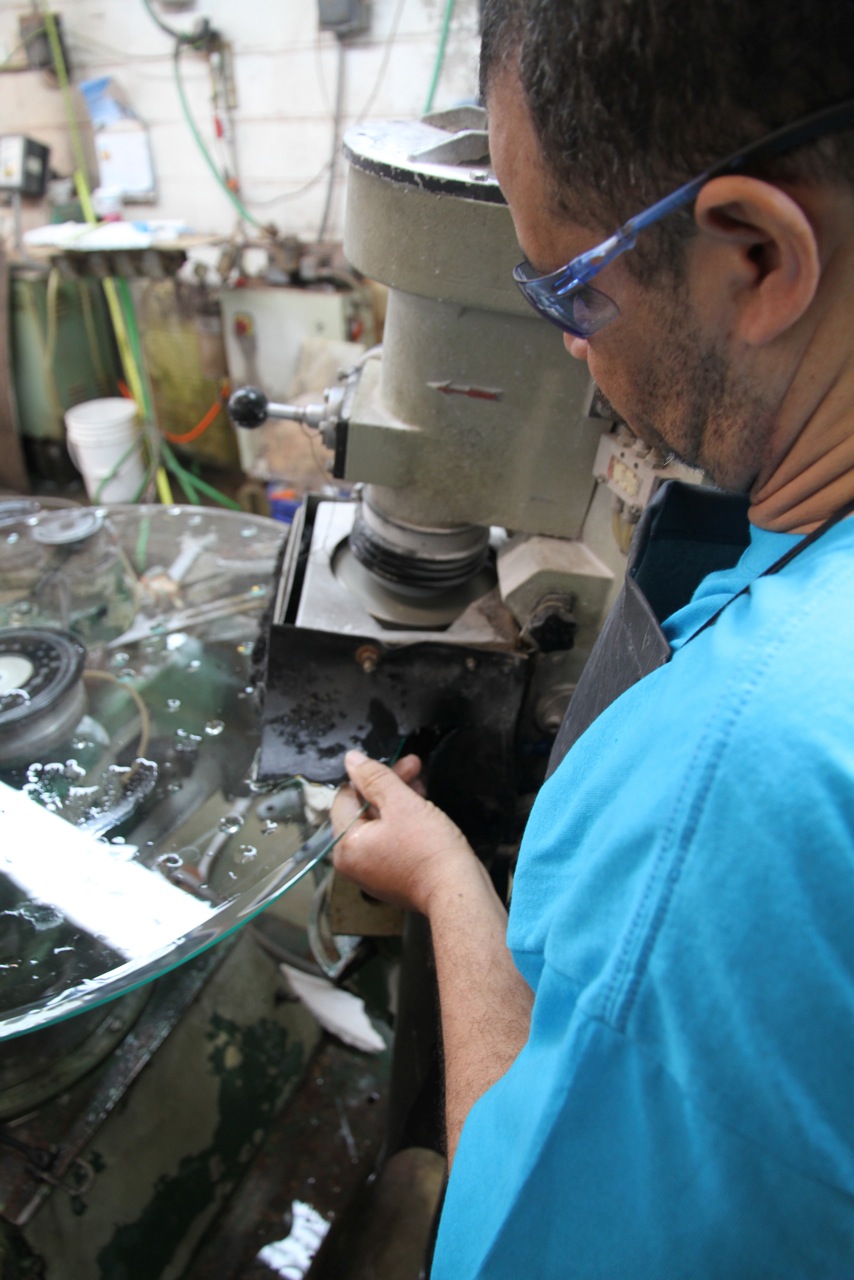
Glass edgework at Bear Glass is a multi-stage process combining CNC-controlled grinding machinery with the hands-on expertise of glaziers who have honed their craft over decades. Each profile requires a different grinding wheel, a different pass sequence, and a different polishing medium.
Specification Review
Every order begins with a thorough review of the edge specification against the glass type, thickness, and end use. A 1/2″ flat polish on 3/8″ tempered glass has very different tolerances than a decorative ogee bevel on 3/4″ annealed glass.
Rough Grinding
Diamond grinding wheels remove the raw arris and shape the basic profile. This stage determines the dimensional accuracy of the final edge and removes all micro-fractures from the cut.
Fine Grinding & Shaping
Progressively finer abrasive wheels refine the profile and remove scratches from the rough grind. For complex profiles like ogee or waterfall, skilled hand work ensures the curve is smooth and consistent across the full run.
Polishing
Cerium oxide polishing compounds on felt or cork wheels bring the ground surface to optical clarity. This is what separates a flat grind from a flat polish — and the difference is visible from across the room.
Quality Inspection
Every edgeworked panel is inspected against the specification before dispatch. Edge consistency, surface clarity, dimensional accuracy, and the absence of chips or scratches are all verified before the order ships.
Decision Guide: Choosing the Right Edge Profile
The optimal edge profile depends on answering four questions clearly before fabrication begins. Bear Glass representatives can advise on each — but here is a working framework.
Is the edge visible in the finished installation?
If yes, the edge is a design element. Polished profiles — flat polish, pencil polish, bevel — are the minimum standard. Decorative profiles like ogee and waterfall are strong options. If no, a seamed edge provides safety without the additional cost of a full polish.
Will people touch the edge regularly?
Table tops, shelves, railings, and shower enclosures are all touched constantly. These always warrant a fully polished edge. A pencil or flat polish removes any residual texture and feels completely smooth under the fingertip.
What is the glass thickness?
Thicker glass (1/2″ and 3/4″) supports the widest range of decorative profiles. Many decorative options — waterfall, ogee bevel — require minimum thicknesses to provide enough material for the grind. Bear Glass‘s specifications list exactly which profiles are available at each thickness.
What is the overall design language of the space?
Contemporary and minimalist interiors typically favor flat polish or pencil polish — clean, invisible lines that let the glass speak for itself. Traditional or luxury residential projects often call for bevel or ogee profiles that add visual weight and classical character.
“For products where the edge of the glass is showing, you need edgework. From glass table tops to glass display cases, all need proper edgework. Different types of edgework are applicable on different types of products.”
Four Decades, Three Generations, One Standard of Excellence
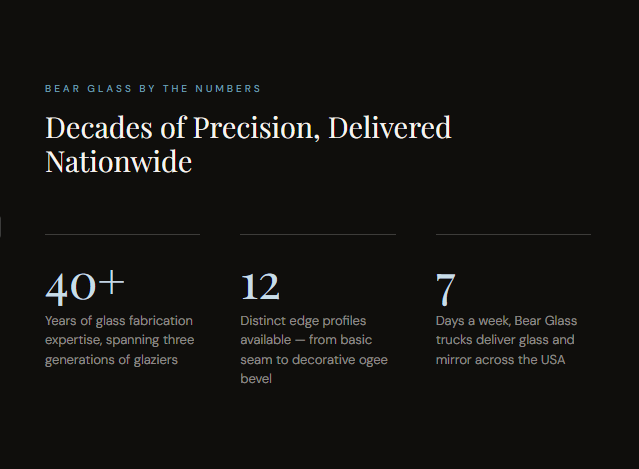
Bear Glass is not a sheet-metal shop that happens to cut glass. It is a full-service glass fabrication house — one of the largest stocking distributors of glass and mirror sheets in the United States — with specialized expertise built over more than four decades and passed down through three generations of glaziers.
The company operates facilities in Queens Village, NYC and Tinton Falls, NJ, with a fleet of dedicated glass delivery trucks running seven days a week. Whether the order is a single custom tabletop for a Brooklyn apartment or eighty pieces of wire glass for a commercial construction project, Bear Glass delivers with speed, accuracy, and craftsmanship.
Bear Glass handles edgework on glass, for residential and commercial applications, and ships nationwide. The available profiles cover every application from the purely functional seam to the most elaborate decorative ogee bevel — with experts on hand to advise on the right specification for every project.
For contractors, installers, interior designers, and architects working across the Northeast and beyond, Bear Glass offers something rare: the stock, the capability, and the expertise to turn around complex edgework orders at competitive prices without compromising with quality. To know more, write to sales@bearglass.com