Ask any glazier where a glass panel actually fails, and the answer is rarely the middle of the lite. It’s the edge. Every cut, score, or waterjet pass leaves behind microscopic flaws — Griffith flaws, in fracture-mechanics terms — that concentrate stress far more than any point on the flat surface of the glass. Edgework isn’t a cosmetic afterthought bolted onto the end of fabrication; it’s the step that determines whether a panel meets its rated strength, passes safety-glazing certification, and survives years of handling, thermal cycling, and site conditions without a spontaneous crack starting at the perimeter.
This guide walks through what edgework actually does, the standard profiles used across the industry, the process from raw cut to finished edge, and the standards that edge quality gets measured against.
Why the Edge Matters More Than It Looks
Glass strength is not a fixed material property the way it is for steel — it’s governed statistically by the size and distribution of surface flaws, a relationship engineers describe using Weibull statistics. A rough, unfinished edge carries a higher density of larger flaws than a ground and polished one, which means two panels of identical glass, cut from the same lite, can have meaningfully different edge strength depending on how the edge was finished. This is a big part of why edge condition matters so much before tempering: any chip, check, or fissure introduced during cutting becomes a stress riser during the heat-treatment cycle and during service life, and it’s far cheaper to catch and correct at the seaming stage than after the glass has gone through the tempering furnace.
That’s also why “edgework” covers more ground than just making an edge look nice. It’s simultaneously a safety measure (removing the razor-sharp arris left by cutting), a strength measure (reducing flaw size and stress concentration), and a design element (bevels, chamfers, and polished profiles that read as intentional detailing on mirrors, tabletops, shelving, and glass railings).

The Edgework Process, Step by Step
Most fabricators follow a broadly consistent sequence, though the exact machinery and number of passes varies by shop and by the finish being targeted.
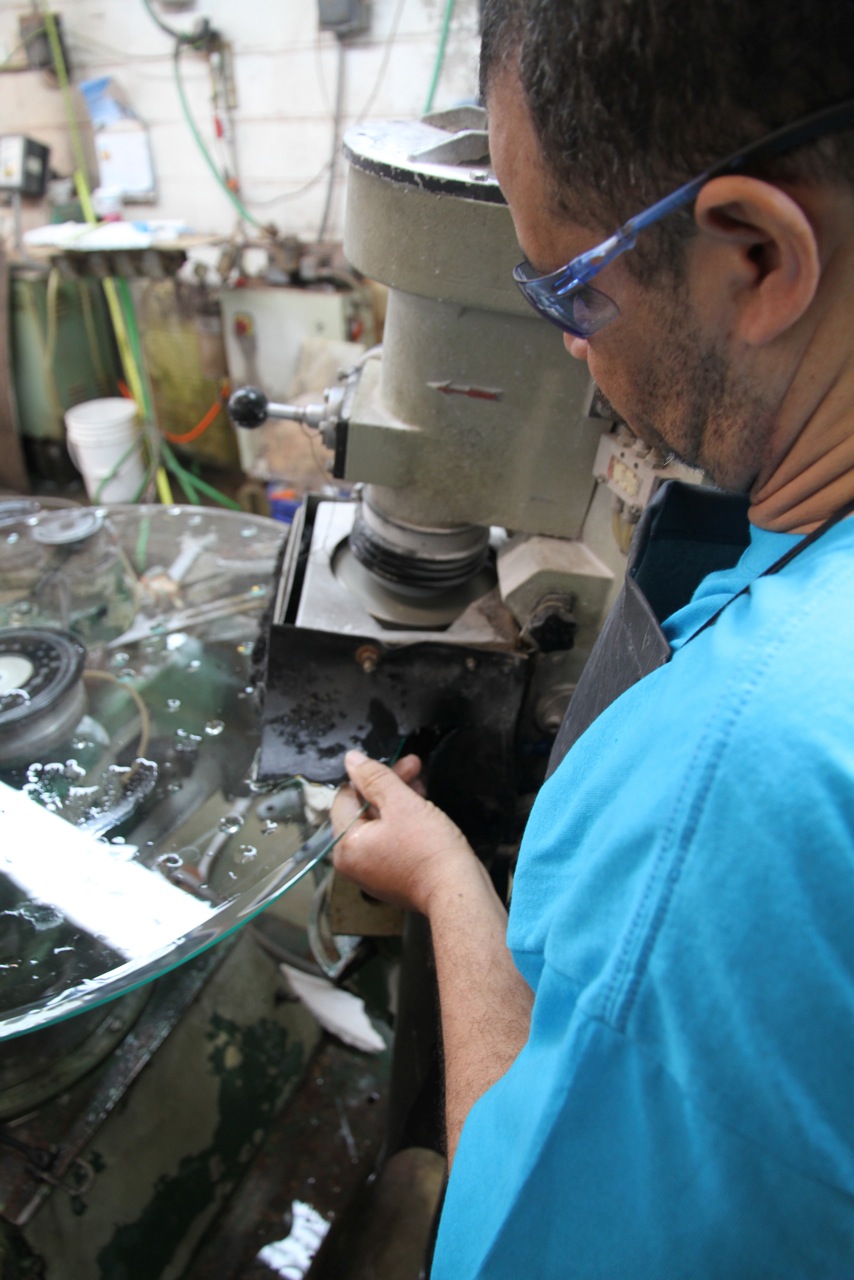
- Seaming. The raw cut edge is run through a seaming machine fitted with diamond-coated wheels to knock off the sharp arris and rough spots left by the cutter. This is the minimum acceptable finish for glass that won’t be visible or handled directly — it removes the danger without yet addressing smoothness or gloss.
- Grinding. Progressively finer abrasive wheels take the seamed edge down to the target profile — flat, pencil, bevel, or otherwise — removing subsurface damage left by the cutting wheel and closing up the flaw population that drives edge strength.
- Polishing. Polishing wheels and compounds bring the ground edge to a high-gloss, optically clear finish. Depending on the shop, this is done mechanically (felt or resin-bonded wheels with cerium oxide or similar compounds) or, less commonly for standard architectural work, through flame or chemical polishing.
- Beveling (where specified). For decorative work, the edge is ground and polished at an angle rather than flat, producing the faceted look associated with beveled mirrors and glass doors. Bevel width and angle are chosen to suit the design — wider bevels read as more substantial, narrower ones as more subtle.
- Arrissing. Even on a flat or seamed edge, the top and bottom corners get a light radius or chamfer so there’s no residual sharp line where the edge meets the face of the glass — important both for handling safety and for reducing edge chipping in transit.
- Quality control. Finished edges are inspected under raking light for chips, checks, subsurface damage, and inconsistent gloss before the piece moves on to tempering, laminating, or shipping. This inspection matters more than it might seem — a flaw invisible under normal light can act as the origin point for a delayed spontaneous break once the glass is under load.
Standard Edge Profiles
Fabrication shops generally offer a consistent set of named profiles, each suited to different applications:
- Seamed edge — the baseline safety finish; arris removed, not polished. Used where the edge won’t be seen or touched.
- Flat polish — a squared, high-gloss edge. The standard choice for shelving, tabletops, and mirror edges that will be visible.
- Pencil polish — a rounded, “pencil-shaped” profile ground into the edge and polished. Common on frameless shower doors and mirrors where a soft edge feels safer to the touch.
- Chamfer edge — a narrow flat angle ground at the corner rather than a full bevel; a lighter design touch than a full bevel.
- Bevel edge — an angled, polished facet cut into one or both faces of the edge, typically specified in widths from 1/8″ up to 3/4″ depending on glass thickness. Beveling both edges of a panel produces a heavier, more dimensional look than a single bevel.
- Miter edge — edges cut and polished at precise angles (commonly 45°) so two panels can be joined into a clean corner, as in glass showcases or frameless enclosures.
- Clean cut — a straight cut with no additional finishing beyond the cut itself, generally reserved for edges that will be captured in a frame or channel and never exposed.
Availability by thickness varies — bevels, for instance, are typically offered from 1/8″ up through 3/4″ glass, while seamed and clean-cut edges can generally be run on any thickness since they don’t depend on a ground profile.

Where Edge Finish Intersects Safety Standards
In North America, safety glazing used in hazardous locations — doors, sidelites, shower enclosures, railings — has to meet ANSI Z97.1, the American National Standard for safety glazing materials, alongside the federal CPSC 16 CFR 1201 requirement for many residential applications. ANSI Z97.1 doesn’t dictate how a fabricator has to finish an edge; it sets performance requirements the finished, tempered, or laminated product has to pass, including impact testing and, for tempered glass, a center-punch fragmentation test confirming the glass breaks into small, relatively dull fragments rather than sharp shards. Tempered glass can also be checked visually for edge condition — chips, cracks, or unevenness on the edge are treated as a red flag, both because they weaken the piece and because they can indicate the glass wasn’t processed correctly before tempering.
That’s the practical throughline for edgework: a clean, properly ground and polished edge isn’t just easier to certify — it’s a meaningful part of what makes the certification hold up over the life of the installation.
Equipment Behind the Process
Consistent edge quality comes down to the equipment and abrasive progression a shop runs:
- Seaming machines with diamond-coated grinding wheels
- Grinding machines for profile shaping
- Polishing machines with felt or resin wheels and polishing compounds
- Beveling machines for angled profiles
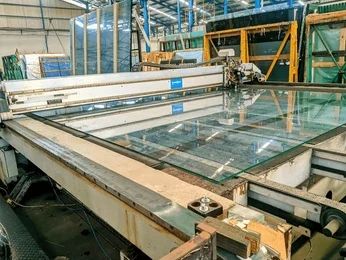
- CNC edging lines, in higher-volume shops, that combine seaming, grinding, and polishing into a single pass with tighter dimensional control
Choosing the Right Finish
For fabricators specifying edgework on a job, the practical decision usually comes down to three questions: Will the edge be visible or handled directly (favor flat or pencil polish over seamed)? Is the piece being tempered or laminated (edge condition going into the furnace matters more than it does for annealed glass that will stay in a frame)? And does the application call for a design detail — a bevel or chamfer — or is a clean, minimal edge the goal? Getting that specification right at the front end saves rework and keeps the finished piece performing the way it’s supposed to, both structurally and visually.
Bear Glass Inc. provides seamed, polished, and beveled edgework for architectural, decorative, and industrial glass at its Queens Village, NY and Tinton Falls, NJ facilities. Request a quote or explore the full range of glass edgework options.