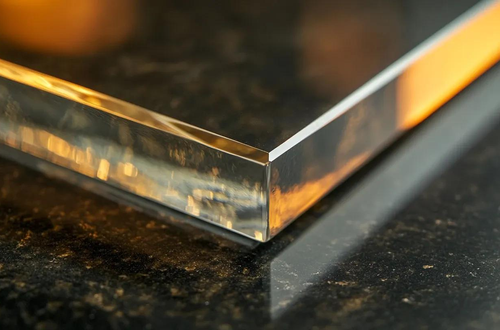
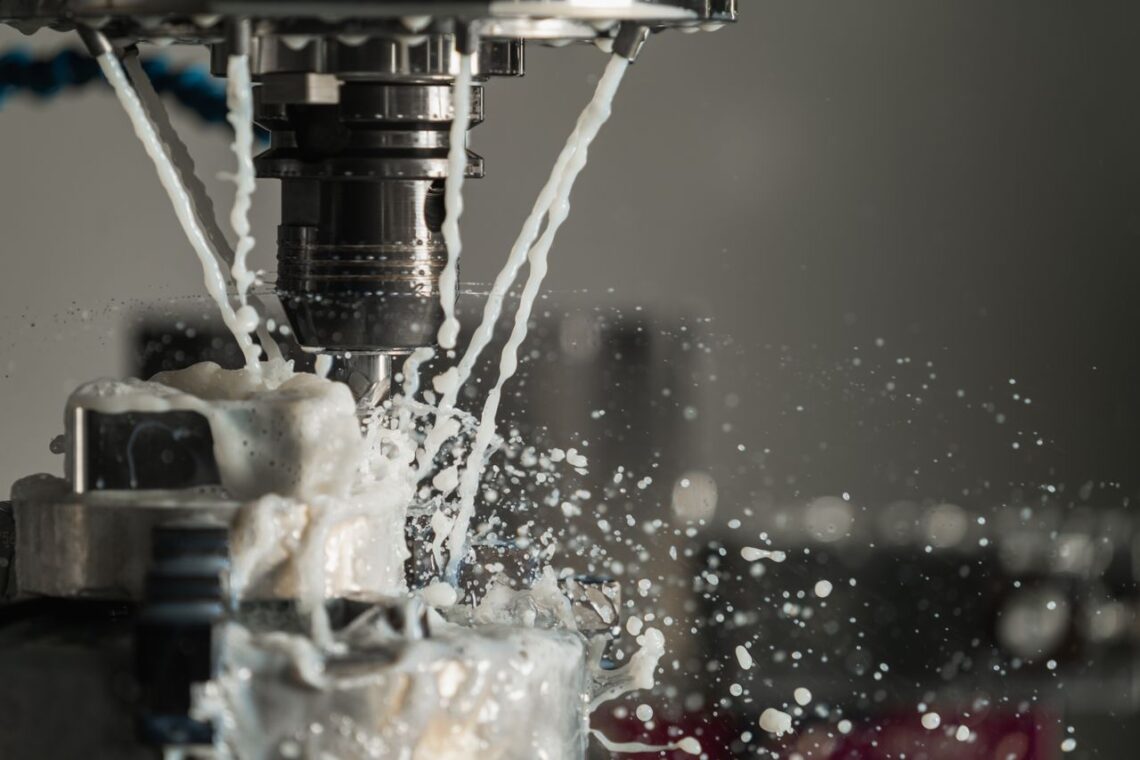
For specifiers and glazing contractors, the question is no longer whether waterjet can cut a complex glass profile. It can. The question is how tightly the finished lite holds to the drawing, how repeatable that is across a 200-unit run, and how much rework the next stage (edgework, tempering, IGU assembly, field install) has to absorb.
In 2026, that gap between “cut” and “cut to tolerance, every time” is where machine generation matters. Here is where we see the real gains, and what we ask of any process feeding architectural and commercial glazing.
1. Taper is the tolerance killer, and it is now largely a solved problem
A waterjet stream has an inherent lag and spread, so an uncorrected cut produces a tapered edge. On thick laminated or 19 mm monolithic lites, that taper shows up as dimensional drift between top and bottom faces and as edge geometry that no longer matches the template.
Current dynamic 5-axis heads compensate by tilting the nozzle against the programmed path in real time, with the tilt calculated from material thickness, cut speed and quality setting. What has changed recently is the quality of the model behind that compensation. Newer control software accounts for how the taper behaves through corners and small-radius features, which is exactly where older compensation tended to undercut or overcut.
What we look for:
- Taper-compensated edges on both faces of thick lites, verified on the finished part, not only in the CAM preview
- Corner and inside-radius behavior that holds when feed rate drops
- Tilt-axis calibration routines that are run and logged on a schedule, not only after a crash
2. Closed-loop pressure and abrasive control
Precision loses ground when the cutting stream is not constant. Pressure ripple from the intensifier, abrasive feed variation and orifice or mixing tube wear all change kerf width and cut quality mid-job.
The 2026 generation of pumps in the 60,000 to 90,000 psi class pairs pressure sensing with active regulation, so the stream stays consistent through a long nesting run. Abrasive metering has followed the same path, with mass-flow feedback replacing open-loop hopper feed on better systems. For glass this matters more than for many metals, because an inconsistent stream shows up as edge chipping, feathering and inconsistent kerf, all of which are visible on exposed edges.
Consumable management is the unglamorous half of this. Mixing tube and orifice wear directly widens the effective kerf. Shops that track consumable hours and replace on data rather than on symptoms hold tolerance far more consistently. Ask any fabricator how they decide when a nozzle is done.
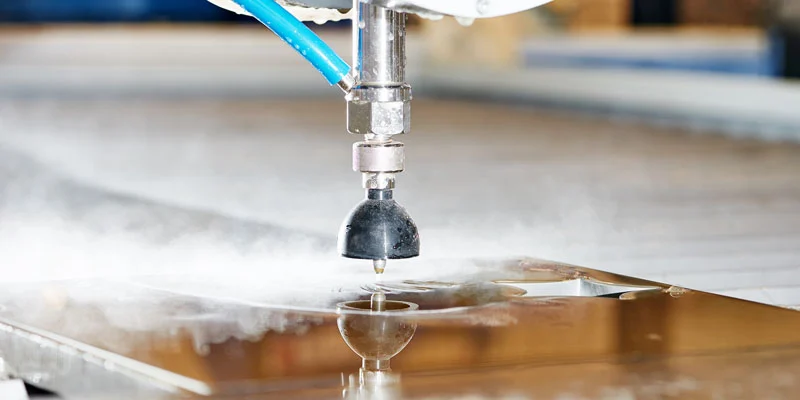
3. Kerf compensation is only as good as your measurement
Toolpath kerf compensation assumes you know the kerf. That number is not a constant. It changes with abrasive mesh, garnet condition, pressure, standoff distance and nozzle wear.
Best practice is to run test cuts, measure them, and feed the measured kerf back into the program for the specific job conditions, rather than relying on a default value from the last time the machine was set up. For tight-fit applications such as inset panels, glass-to-metal interfaces, and cut-outs receiving hardware, we treat kerf verification as a step in the job, not a one-time calibration.
4. Machine vision and datum control
Where a lite arrives with pre-existing features (a previously cut profile, drilled holes, or a printed or fritted pattern that must register to the cut), placement error on the table becomes part-to-part error. Vision-assisted registration lets the machine locate the actual position of the glass and correct the program to it, instead of relying on an operator to square the sheet against stops.
This is especially valuable for:
- Cuts that must align to ceramic frit or silkscreen patterns
- Secondary operations on pre-processed lites
- Remnant and irregular-stock utilization, where the sheet is not a clean rectangle
5. Piercing strategy for laminated and heat-treated glass
Piercing is where glass is most likely to fail, and it is where process discipline shows. Uncontrolled piercing can cause delamination at the interlayer, star cracking, and stress that propagates into the cut.
Modern controls support low-pressure ramped pierces, dynamic pierce logic that adjusts by material and thickness, and lead-in geometry placed in scrap regions so the pierce point never lands on the finished edge. For laminated lites, controlled pierce parameters also protect the interlayer bond line, which matters for both appearance and long-term edge performance.
One point we hold firmly: profile cutting belongs before tempering. Fully tempered glass cannot be waterjet-cut after the fact without shattering, so the sequence is cut, finish the edge, then temper. Precision in the cut stage must anticipate what the edge will look like after edgework and how the lite will move through the furnace.
6. Thermal and structural stability of the machine itself
Repeatability is a machine-condition question as much as a process question. Bridge and rail stiffness, drive and encoder quality, and thermal stability of the frame all affect positional accuracy over a full shift. Better systems now include temperature compensation and periodic volumetric calibration. In a shop running multiple shifts, that is the difference between the first part and the four-hundredth part matching.
7. Nesting, sequencing and heat-free stress management
Because waterjet glass cutting is a cold process, it avoids the heat-affected zone issues of other cutting approaches. It does not, however, eliminate the internal stress of the sheet itself. Cutting sequence still matters: cutting inside features first, and ordering cuts to keep the sheet supported and balanced, reduces the risk of movement and breakage on thin or highly nested layouts.
Advanced nesting now models these sequencing constraints along with material yield, so tight nests do not come at the cost of stability. On expensive substrates such as low-iron, coated or laminated glass, the yield gain is meaningful on its own.
8. Quality documentation is part of precision now
On commercial and institutional projects, the ability to demonstrate conformance is increasingly part of the deliverable. Fabricators that log cut parameters, calibration checks and dimensional inspection against drawing tolerances give architects and contractors a paper trail that speeds submittal review and settles disputes quickly.
What to ask your fabricator
If you are specifying waterjet-cut glass for a project, these questions separate capability from marketing:
- What tolerance do you hold on the specific geometry and thickness in my drawings, and how is it verified?
- Is the head taper-compensated, and how often is tilt calibration checked?
- How do you determine and update kerf compensation for each job?
- How do you handle pierce placement on laminated and coated glass?
- What is your sequence with tempering and edgework, and who owns dimensional responsibility at each stage?
- Can you provide inspection records with the delivery?
Precision waterjet fabrication from Bear Glass
Bear Glass serves architects, builders, glazing contractors and commercial specifiers across New York and New Jersey. If you have a profile, cut-out or tolerance requirement that pushes standard practice, send us the drawings early. Resolving cut sequence, edge requirements and tolerance stack-up at the design stage is far cheaper than resolving them at install.