The Edge Is More Than a Finishing Touch
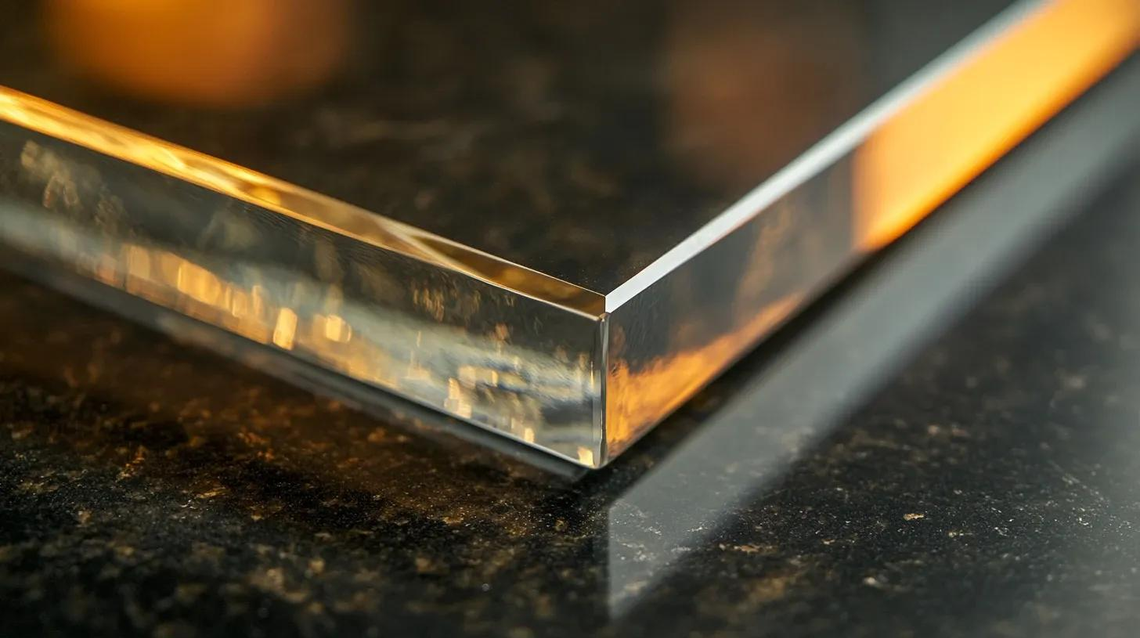
When most people picture a glass tabletop, they picture the surface — the clarity, the reflection, the way it sits on a base. What they rarely picture is the edge. But the edge is where a glass tabletop is actually experienced. It’s what a hand rests against while eating dinner, what a hip brushes past walking through a living room, what catches the eye first when light hits it at an angle.
The edge profile a fabricator chooses does four things at once. It shapes the visual character of the piece — soft and rounded versus crisp and architectural versus faceted and light-catching. It determines how the glass feels to the touch, which matters enormously for anything used daily, like a dining table or desk. It governs safety, since an improperly finished edge on tempered or annealed glass is a genuine hazard, not a cosmetic issue. And it affects long-term durability, because a poorly ground or seamed edge is more vulnerable to chipping and stress fractures than one that has been correctly processed.
In other words, the edge isn’t a finishing touch applied after the “real” work is done. It’s a structural and design decision in its own right — and getting it right requires understanding both the mechanics of how glass edges are made and the aesthetic logic of which profile suits which piece of furniture.
2. What Is Glass Edgework?
Glass edgework refers to the sequence of processes used to take a freshly cut sheet of glass — with its raw, sharp, unfinished perimeter — and turn that edge into something safe, smooth, and visually intentional.
Cut glass edges are dangerous in their raw state. They’re sharp enough to cause lacerations and prone to micro-chipping, which can propagate into larger cracks under stress. Edgework exists to solve both problems while also giving fabricators a design tool.
The general process moves through several stages:
- Grinding — The raw cut edge is ground down using diamond abrasive wheels to remove the sharpest material and establish the rough shape of the intended profile.
- Shaping — For decorative profiles (bevel, OG, pencil), the edge is run through shaping wheels that cut the specific angle or curve into the glass.
- Smoothing — Progressively finer abrasives are used to eliminate the ridges and tool marks left by grinding and shaping, refining the surface texture of the edge.
- Seaming or Polishing — Depending on the desired finish, the edge is either seamed (a light, matte smoothing pass that removes sharpness without full polish) or polished (a high-gloss finish achieved through fine polishing compounds and felt or cerium-oxide wheels) until it reaches the level of clarity and shine specified.
The specific combination and sequence of these steps — and the precision with which each is executed — is what separates a mass-produced edge from one that reads as genuinely high-end.
3. The Best Glass Edge Profiles for Tabletops
Pencil Edge
Appearance: A pencil edge is a fully rounded profile — imagine the cross-section of a pencil, hence the name — with no flat facets or sharp transitions anywhere along the edge.
Feel: Soft and smooth to the touch, with no perceptible corners. It’s the most forgiving profile for hands, elbows, and anyone who brushes past the table frequently.
Best application: Dining tables, coffee tables, and desks in households with children, or any setting where frequent contact with the edge is expected.
Design style: Contemporary and casual-modern interiors. The rounded form softens the overall look of a glass piece, making it feel less severe than sharper-edged alternatives.
Flat Polish Edge
Appearance: A single flat plane running perpendicular to the glass surface, polished to a high gloss with crisp, right-angled transitions at the top and bottom.
Feel: Clean and precise, with a defined edge line that’s still safe to the touch once properly polished, though less “soft” than a pencil edge.
Best application: Minimalist tabletops, glass desks, and shelving where a sharp, architectural line is part of the design intent.
Design style: Modern and minimalist. This profile reads as deliberate and understated — it doesn’t try to decorate the glass, it lets the glass’s clarity and the flatness of the line speak for themselves.
Beveled Edge
Appearance: An angled facet ground into the perimeter of the glass, typically at 45 degrees, though the angle and width can be customized. The bevel creates a distinct secondary plane along the edge.
Feel: The angled surface is smooth but introduces a visible transition line where the bevel meets the flat top surface, giving the edge a tactile sense of depth.
Best application: Statement dining tables, console tables, and mirrored or decorative tabletop applications where light interaction is part of the appeal.
Design style: Traditional through transitional. Beveled edges catch and refract ambient light along the angled facet, creating a subtle prism effect that reads as more ornamental than a flat or pencil edge — well suited to spaces with a more classic or layered design sensibility.
OG Edge (Ogee Edge)
Appearance: A double-curved, S-shaped profile combining a concave and convex curve, producing a much more elaborate silhouette than the other profiles on this list.
Feel: The most tactile and dimensional edge of the group, with a pronounced sense of contour under the fingers.
Best application: Formal dining tables, traditional furniture reproductions, and statement pieces meant to anchor a room.
Design style: Traditional and ornate. The OG edge is the closest glass equivalent to carved wood molding profiles, and it’s typically chosen when the goal is to make the tabletop itself a decorative feature rather than a neutral surface.
Seamed Edge
Appearance: A minimally processed edge — the sharpness of the raw cut is removed, but the surface remains matte rather than polished, with no shaping into a decorative profile.
Feel: Smooth enough to be safe, but noticeably less refined than a polished profile; there’s no shine or crisp visual line.
Best application: Glass that will be inset into a frame, used as shelving where the edge won’t be visible or touched directly, or budget-conscious projects where a polished finish isn’t necessary.
Design style: Utilitarian. A seamed edge is a functional baseline rather than a design statement — appropriate when the edge itself isn’t meant to be a visual focal point.
4. How to Choose the Right Edgework
Table Style
The furniture style is usually the strongest signal for which profile belongs on a given piece:
- Modern → Flat Polish or Pencil Edge. Both profiles support clean lines and an unornamented aesthetic.
- Contemporary → Pencil or Beveled Edge. Contemporary spaces can absorb a bit more softness or light-play without breaking from the overall design language.
- Traditional → OG or Beveled Edge. These more elaborate profiles complement the layered, decorative character typical of traditional interiors.
Table Thickness
Glass thickness has a direct effect on which profiles are practical. Thinner glass — in the 3/8″ range — has less material to work with, which limits how pronounced a bevel or OG profile can be before the design starts to look disproportionate to the piece. Thicker glass, typically 1/2″ and up, gives fabricators more room to cut a deeper, more dramatic bevel or a fuller OG curve without compromising the structural integrity of the edge. As a general rule, more elaborate profiles look and perform best on thicker glass, while thinner glass tends to suit simpler profiles like pencil or flat polish.
Safety & Usability
For furniture that gets touched constantly — dining tables, coffee tables, desks — edge finishing isn’t optional, it’s functional. A properly ground and polished or seamed edge eliminates the micro-sharpness of raw cut glass and removes the risk of cuts from everyday contact. This matters even more in households with children, in commercial settings with high foot traffic, or on any surface positioned at hip or hand height where contact is frequent and often incidental. Edge profile selection should always account for how the table will actually be used, not just how it will look in a showroom.
Lighting & Aesthetics
Edge profile has a real effect on how a piece of glass furniture interacts with light. A flat polish edge produces a crisp, thin line of brightness along the glass perimeter. A beveled edge does something more dynamic — the angled facet refracts and bends light, often producing small color-separated highlights along the bevel, especially under direct or angled lighting. An OG edge, with its double curve, creates multiple light-catching surfaces at once. Pencil and seamed edges, by contrast, diffuse light more evenly and produce a softer, less attention-grabbing effect. If a tabletop is meant to be a visual centerpiece, the edge profile’s relationship to light should be part of the decision, not an afterthought.
5. Pencil Edge vs. Flat Polish vs. Beveled Edge
These three profiles account for the large majority of tabletop edgework requests, and they’re often the ones customers are actively weighing against each other, so it’s worth comparing them directly.
Pencil Edge is the softest option in every sense — visually rounded, physically forgiving to the touch, and the safest choice for high-contact furniture. It suits contemporary and casual interiors where comfort and approachability matter more than a sharp design statement.
Flat Polish Edge is the most architectural of the three — a crisp, single-plane edge with a defined line. It’s the right choice when the design goal is minimalism and precision, and when the table won’t see the kind of constant close contact that would make a rounded edge preferable.
Beveled Edge is the most decorative of the three — it introduces an angled facet that catches light and adds visual depth without going as far as an OG profile. It works well when a table needs to feel more elevated or traditional without becoming overtly ornate.
As a shorthand: choose pencil for comfort and softness, flat polish for architectural minimalism, and beveled edge for light-play and traditional elegance.
6. Why Precision Matters in Glass Edgeworking
A beautiful tabletop is decided long before it reaches the furniture frame — it’s decided on the fabrication floor, in the details that most customers will never consciously notice but will absolutely feel.
Consistent edge dimensions. A bevel that’s 1/2″ wide at one end of the table and 7/16″ wide at the other reads as an obvious flaw once the light catches it. Precision fabrication holds the profile’s width and angle consistent along the entire perimeter, including around corners and curves.
Smooth transitions. Wherever one plane of the edge meets another — where a bevel meets the flat top surface, or where a curve reverses direction on an OG profile — that transition needs to be clean and continuous. Rough or uneven transitions are visually obvious and can also become stress points in the glass.
Uniform polishing. Polish quality that varies across the length of an edge creates visible dull spots or hazy patches under light, undermining the high-end look the profile was chosen to achieve in the first place.
Removal of sharp edges. Every stage of the process exists partly to guarantee that no sharp or under-finished section remains, since a single missed spot is enough to create a safety liability on an otherwise well-fabricated piece.
Surface quality. Micro-scratches, chatter marks from grinding wheels, or residual haze from an incomplete polishing pass all detract from the clarity that makes glass furniture desirable in the first place.
Inspection and quality control. None of the above matters without a rigorous final inspection process — checking dimensional consistency, polish quality, and edge integrity under strong lighting before a piece is approved to leave the shop.
The takeaway is straightforward: the edge profile a customer selects is only half the equation. The precision with which that profile is executed determines whether the finished piece looks and feels genuinely premium, or merely adequate.
7. Common Mistakes When Selecting Tabletop Edgework
- Choosing an edge purely based on appearance. A beveled or OG edge might look stunning in a photo, but if the table will be used daily by a family with young kids, prioritizing decoration over comfort and safety often leads to regret.
- Ignoring the table’s overall design. An edge profile that clashes with the rest of the furniture — an ornate OG edge on an otherwise stripped-down minimalist frame, for instance — can undercut the coherence of the whole piece.
- Selecting an unsuitable profile for the setting. A highly reflective, light-catching bevel might be the wrong choice for a table that sits directly under harsh overhead lighting, where the light-play can become distracting rather than elegant.
- Overlooking glass thickness. Requesting a deep, dramatic bevel or OG profile on thin glass can result in a disproportionate, structurally weaker edge that doesn’t hold up the way it would on thicker stock.
- Failing to consider how the table will be used. A desk that sees constant contact from forearms and sleeves has different edge requirements than a decorative side table that’s rarely touched directly.
- Prioritizing decoration over practicality. The most elaborate profile isn’t always the best one. The right edge is the one that balances how the table looks with how it will actually be lived with.
8. Bear Glass: Where Glass Meets Craftsmanship
Choosing the right edge profile means balancing design intent, glass thickness, daily usability, and how the piece will interact with light in its final setting — and getting every one of those variables right takes both technical precision and design experience.
That’s the role Bear Glass plays for architects, designers, fabricators, and homeowners alike: a partner that helps determine the appropriate glass thickness, edge profile, finish, and fabrication requirements for a tabletop project from the outset, rather than after problems show up. Whether the goal is a minimalist flat-polished desk, a light-catching beveled dining table, or a traditional OG-edged statement piece, the difference between a good result and a great one comes down to the precision applied at every stage of the edgework process.
If you’re planning a glass tabletop project and want guidance on the right profile, thickness, and finish for your specific design and use case, Bear Glass can help you get it right the first time.